This article explores how the philosophy of Chinese calligraphy and Daoist thought can reveal a deeper understanding of health, circulation, and the natural flow of movement within the human body.
What Chinese Brush Calligraphy
Can Teach Us About Health
By Zhen Hua Yang
Introduction: Health as Flow
What if health worked in the same way? In traditional Chinese thought, circulation, especially blood flow, is central to vitality. When circulation is smooth, the body feels warm, nourished, and alive. When it stagnates, discomfort and fatigue arise. The image of water flowing through valleys mirrors the rivers within us.
When circulation is smooth, the body feels warm, nourished, and alive.
Many contemporary movement systems rely heavily on muscular effort. We contract, push, tighten, and strive to improve flexibility or strength. But what if movement could be guided by internal flow rather than external force?
The Body as the Brush
For centuries, calligraphy expressed the movement of qi through the brush. Yet the principle remained largely confined to ink and paper.
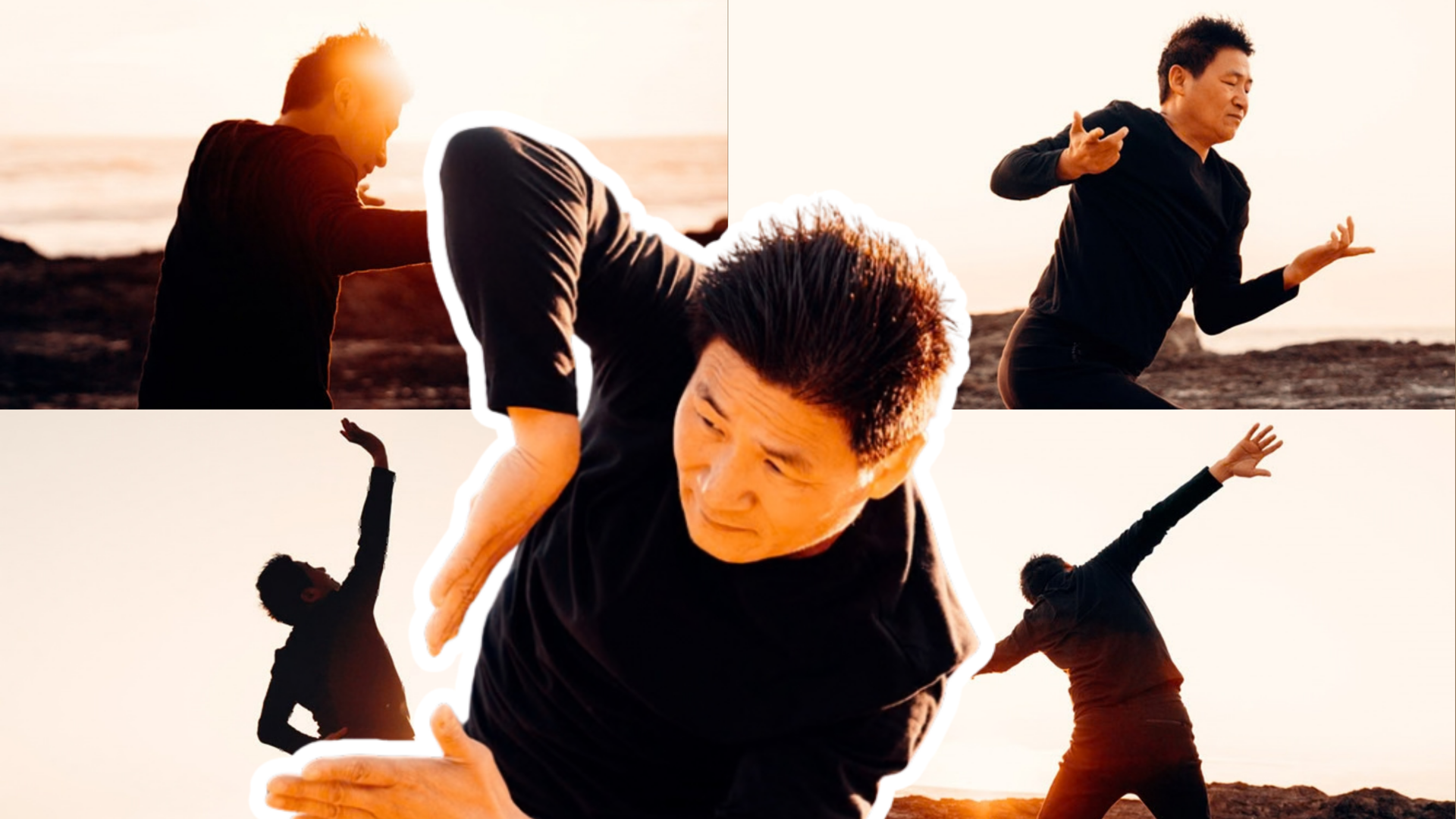
Master Zhen Hua Yang, a Chinese Australian teacher trained in traditional Chinese martial and internal arts traditions, translated these foundations into a system of health based on whole body movement. He extended the art and philosophy of calligraphy beyond the wrist and arm, developing a system in which the entire body becomes the brush.
The Meaning of Calligraphy
In Chinese, the word for calligraphy, 书法 (shūfǎ), literally means “the method of writing.” From its origin, it referred not to an object on paper but to an act, movement through which meaning becomes embodied.
For centuries in China, calligraphy was never considered merely decorative. Philosophers described the brushstroke as the visible trace of qi, the vital energy that animates all living things. When body, breath, and mind align, qi flows through the calligrapher’s arm into the brush, and the resulting line reveals the inner state of the writer.
- A tense mind produces a rigid line.
- A scattered mind produces a broken one.
- A balanced, present mind produces movement that is fluid and alive.
In this sense, calligraphy is not about creating beauty. It is about allowing life to move unobstructed. The philosophy behind calligraphy does not end with ink.
Water as Teacher
Daoist philosophy, especially as expressed in the classical text Dao De Jing, repeatedly turns to water as a model of harmony.
Water yields yet overcomes. It flows downward without striving. It does not compete, yet nothing can resist it.
After rain falls on a mountain, water finds its own path, adjusting around rocks, nourishing roots, carving valleys over time. It does not force. It follows its nature.
Movement Guided by Circulation
In this approach, the visible gesture is guided by internal circulation rather than muscular force. Body movement begins not in the limbs but deep within the body, in the inner circulation of blood and qi.
The arms do not initiate action; they transmit it.
The muscles do not push; they respond.
Practitioners often report warmth spreading through the limbs or a subtle pulsation in the palms as circulation becomes more continuous.
Movements begin not in the limbs but deep within the body.
Instead of shaping the body from the outside, practitioners learn to sense the flow within and allow it to guide structure, alignment, and rhythm. The experience is often described as being moved from within, as if an inner current were reorganising the body in real time.
The core principle is simple: just as a brushstroke reveals the state of the calligrapher, bodily movement reveals the condition of one’s circulation. When circulation becomes continuous and unobstructed, movement regains fluid coherence. Power appears without rigidity. Stability arises without tension.
He called this translation of calligraphy into embodied practice
Calligraphy Health, a system built on the premise that vitality depends on the smooth flow of blood.
The Body as a Living Painting
In classical calligraphy, the finished piece is said to reveal the writer’s character. Not personality in the psychological sense, but vitality, presence, coherence, depth.
The same can be said of how we move. Our posture, our gestures, even the way we walk reflect our inner state.
When we are anxious, our movements fragment.
When we are exhausted, they lose rhythm.
When we are balanced, motion becomes continuous and integrated.
In this light, every movement is a form of writing. We are constantly inscribing ourselves into space through the way we sit, reach, breathe, and relate.
The body becomes a living canvas, each gesture a brushstroke revealing the landscape within.
Health, then, may not be something we “achieve.” It may be something we allow by restoring flow, reducing inner friction, and moving in accordance with what is natural.
Experience the principles of Calligraphy Health in action through practical demonstrations and guided insights from Master Zhen Hua Yang. Explore the videos below to see how movement, circulation, and natural flow can support vitality and wellbeing.
Explore Calligraphy Health
Continue your journey with Calligraphy Health here on the WWM site. Discover programs and services designed to support natural movement, circulation, and wellbeing, and enjoy 10% off selected services available to readers.
Meet Master Zhen Hua Yang
Internationally respected energy and health expert, carrying a family lineage of over 400 years of internal arts and healing knowledge.
He began practising healing through breathwork at just two years old, taught by his father and grandfather, to help with debilitating asthma. Later in life, he was taught by renowned Buddhist Monk Hai Deng.
Master Yang has also taught many of his own students, such as Australian Olympians Torah Bright and Matt Jaukovic. He works with the Australian military and veterans through the Warrior Revival Program and runs his own wellness retreat in the Gold Coast, Australia.
Both traditional Chinese brush calligraphy and its embodied translation teach the same lesson: health and vitality cannot be forced. They unfold when we return to natural flow.
The body becomes a living canvas.
Share Articles and Blogs
Recent Articles and Blogs